



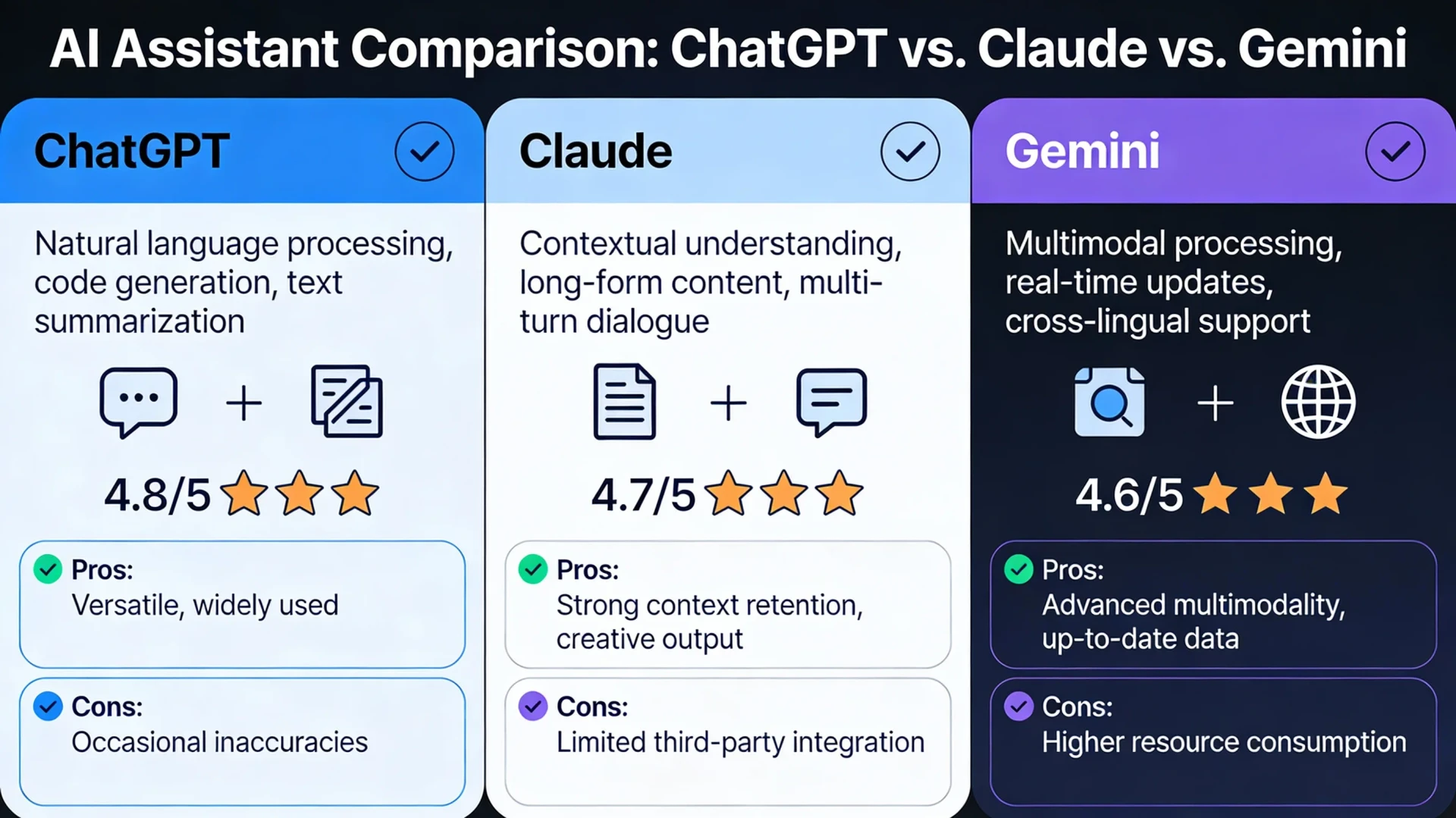
AI Tool Comparisons: How to Pick Your Assistant
New AI models ship every few months, every launch claims to be the best, and half the comparison articles online are outdated by the time you read them. This guide takes a different route: instead of crowning a winner that will be dethroned by Christmas, it gives you a 30-minute test you can run yourself, plus an honest look at where each major assistant tends to be strong. The method stays valid even when the model names change.
The contenders
The four assistants most people choose between in 2026:
- ChatGPT (OpenAI) — the household name, with a large ecosystem of integrations and custom GPTs.
- Claude (Anthropic) — known for long documents, careful reasoning and strong writing and coding.
- Gemini (Google) — woven into Google Search, Gmail, Docs and Android.
- Copilot (Microsoft) — the same class of models, packaged into Windows, Edge and Microsoft 365.
All four have free tiers with daily or hourly usage caps, and paid plans around the price of a streaming subscription. Exact limits and prices change often enough that we will not print them here; check the pricing page on the day you decide.
Why "which AI is best?" is the wrong question
Benchmarks measure averages across thousands of tasks. You do not have thousands of tasks; you have your tasks. An assistant that tops a math benchmark can still be mediocre at drafting your customer emails, and the reverse. The only comparison that matters is on the work you actually do, in the language you actually work in.
The 30-minute test
Open two or three assistants side by side and give each the same five prompts. Use real work, not toy questions.
1. The rewrite test. Paste a real email or paragraph you wrote and ask:
Rewrite this to be half as long without losing any commitments or dates.
Keep my tone.
Look for: did it keep every fact? Did it invent pleasantries you would never write? Does it still sound like you?
2. The document test. Upload the longest real PDF you deal with (a contract, a report) and ask:
List the 5 points in this document most likely to cost me money,
each with the section it comes from.
Look for: does it cite sections you can verify, or does it summarise vaguely? Spot-check two answers against the actual document.
3. The reasoning test. Give it a real decision with real constraints:
I have budget X, deadline Y, and options A and B with these trade-offs: [...].
Recommend one and name the strongest argument against your own recommendation.
Look for: does it actually commit to a recommendation? Is the counter-argument real or a strawman?
4. The code test (if you code). Paste a function from your own codebase, not a textbook example:
Find the bug in this function and explain it before proposing a fix.Look for: explanation before code. An assistant that fixes without explaining teaches you nothing and is harder to trust.
5. The honesty test. Ask something in your field that you know is unsettled or has no clean answer. Look for: does it admit uncertainty, or does it confidently make something up? This one test predicts more day-to-day frustration than any benchmark.
Score it and decide
Give each assistant a 1–5 on every test, in a plain note or spreadsheet. Two patterns emerge almost every time:
- One assistant fits your writing voice and workflow noticeably better than the others. That difference is worth more than any leaderboard position.
- The gap between free tiers is smaller than the gap between free and paid. If AI saves you an hour a week, one paid plan pays for itself; pick the winner of your test and subscribe to that one, not to all four.
Where each one tends to fit
Honest generalisations, not laws — your test can overrule all of them:
- Deep in Google Workspace (Gmail, Docs, Sheets)? Gemini's integration advantage is real and daily.
- Deep in Microsoft 365? The same logic points at Copilot.
- Long documents, careful writing, larger coding tasks? Claude has a strong reputation here.
- Broadest plugin and custom-bot ecosystem? ChatGPT's community is the largest by a distance.
Three mistakes to avoid
- Choosing by headline. "Model X beats model Y" news is about benchmarks, not about your Tuesday afternoon. Retest with your own five prompts when a big release actually lands.
- Pasting confidential data into free tiers. Check your employer's policy and each provider's data-usage settings first; most assistants let you opt out of training on your conversations, but the default varies by plan.
- Treating output as finished work. Every assistant occasionally states falsehoods with full confidence (test 5 shows you how often). The assistant drafts; you verify and sign.
Where to go next
- Sharpen your prompts first — the same model performs wildly better with structure. Start with our prompt engineering tutorial.
- Ready to automate whole workflows instead of single chats? Read the business automation guide, or browse the AI & Automation chapter.
Ran the 30-minute test and got a surprising result? Tell us about it — reader results shape our follow-ups.
Comments
No comments yet. Be the first to share your thoughts.